Your dog destroys things when you leave. You've tried everything. Here's what's actually happening in their brain - and why a simple antler chew addresses it better than most "calming" products.

The guilt is real. You come home to a shredded pillow, scratched door frames, or a neighbor's noise complaint. You've probably spent money on thunder shirts, pheromone diffusers, calming supplements - some of it helps a little, most of it doesn't. What almost nobody tells you is that chewing itself is one of the most powerful anxiety-reduction mechanisms a dog has. And the reason most chews don't help isn't that chewing doesn't work - it's that they're gone in three minutes, before the calming effect ever has a chance to kick in.
That's the key insight this article is built on. Let's walk through the science, the duration problem, and exactly how to use a naturally shed antler chew as a behavioral tool for an anxious dog.
Does Chewing Actually Help Dogs with Anxiety?
Yes - and there's solid physiological reasoning behind it, not just anecdote.
When a dog chews in a sustained, rhythmic way, several things happen in their nervous system simultaneously:
Parasympathetic activation. The act of chewing signals the parasympathetic nervous system - the "rest and digest" branch - to become more dominant. This is the opposite of the fight-or-flight state that anxious dogs are stuck in. Jaw movement and repetitive oral motor activity are known to have calming effects across multiple species, including humans (think: stress eating, gum chewing during exams).
Cortisol reduction. Cortisol is the primary stress hormone. Sustained chewing has been shown to reduce circulating cortisol levels. Behavioral research published in journals including Applied Animal Behaviour Science has found that dogs given long-lasting chews show measurably reduced stress indicators compared to control groups with no chew access. The effect is not trivial - it's a physiological shift, not a distraction.
Serotonin release. Chewing stimulates serotonin production, the neurotransmitter most associated with mood regulation and contentment. This is part of why dogs that have regular chewing outlets tend to have lower baseline anxiety than dogs that don't.
Proprioceptive jaw pressure. This one is underappreciated. Deep pressure and sustained jaw engagement send calming sensory input to the nervous system. The same principle underlies weighted blankets for humans or deep pressure vests for dogs - proprioceptive input has a regulating, calming effect on high-arousal nervous systems. A hard antler that requires real jaw engagement provides this input in a way that soft or easily destructible chews simply cannot.
Chewing isn't just something dogs do because they're bored or being naughty. It is a genuine self-soothing behavior - a built-in stress management tool that domestic dogs use when given the opportunity. The problem is that most modern chews remove that opportunity by disappearing too quickly.
Why Most Chews Aren't Long Enough to Make a Difference
Here's the duration problem nobody talks about.
A nervous system doesn't shift states in two minutes. The parasympathetic response, cortisol reduction, and serotonin stimulation described above require sustained engagement - not a quick snack. Research on stress response timelines suggests it takes roughly 20 - 30 minutes of continuous calming input before a significantly aroused nervous system begins to regulate.
A bully stick consumed in 3 - 5 minutes - common for medium and large dogs - provides about 3 - 5 minutes of chewing. That's not enough time to do anything meaningful for an anxious dog. The chew is gone before the physiological shift begins, often leaving the dog more frustrated and aroused than before.
The same applies to most soft chews, jerky treats, and training treats used as calming tools. They're consumed almost instantly. Wonderful for training, useless for nervous system regulation.
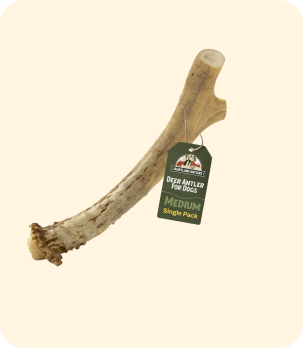
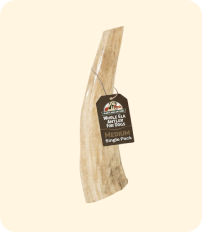
Naturally shed antler chews work differently because of their density. A correctly sized elk or deer antler gives most dogs a 30 - 90 minute chewing session - not because we say so, but because that's what the material physically requires. You cannot speed-run a Grade A antler. The density is the mechanism: it forces the sustained, rhythmic gnawing that generates the calming response.
That 45-minute session isn't just longer. It's long enough. It crosses the threshold where the nervous system actually shifts.
Do Antler Chews Help Dogs with Separation Anxiety?
They can be one of the most practical tools in your separation anxiety toolkit - when used strategically.
Separation anxiety peaks in the first 20 - 30 minutes after departure. This is the window when most destructive behavior happens, most barking occurs, and most stress is experienced. After that initial spike, many dogs (not all, but many) settle into a lower-arousal waiting state. The hardest part is getting through the spike.
Here's how antler chews fit in:
They provide occupation that competes with anxious behaviors. A dog that is actively and intently chewing an antler is not simultaneously pacing, barking, or destroying furniture. The chewing behavior is incompatible with those anxiety behaviors - it occupies the same behavioral and neurological space.
They work through the spike window. A 45-minute antler session covers the entire initial anxiety peak. By the time the antler session winds down, the cortisol response has already begun to reduce on its own.
They can become a positive pre-departure cue. One of the most effective behavioral strategies for separation anxiety is associating departure with something the dog genuinely looks forward to. If your dog only gets their antler when you leave, the sound of your keys or your coat going on starts to predict the antler - not your absence. This is classical counter-conditioning at its simplest.
Practical setup: Give the antler 5 - 10 minutes before you actually leave, not at the door. This gives the dog time to engage with the chew and begin the calming process before the departure stress triggers. Start with split elk antler chews - the exposed marrow activates interest faster, which means anxiety displacement starts sooner.
For dogs with moderate to severe separation anxiety, antler chews are a valuable support tool - but they work best alongside a structured behavior modification program. If your dog is injuring themselves, not eating, or eliminating indoors exclusively when left alone, consult a veterinary behaviorist. Antlers help; they're not a replacement for professional behavioral intervention in serious cases.
Antler Chews for Boredom and Destructive Chewing
Not every dog that destroys things has clinical separation anxiety. Many dogs - particularly high-drive breeds - are simply not getting enough mental occupation. Destructive chewing isn't misbehavior in these dogs. It's a need going unmet.
Huskies, Belgian Malinois, Border Collies, and German Shepherds were bred to work. Their brains need sustained engagement the way their bodies need exercise. When that engagement isn't provided, they find it themselves - in your couch, your baseboards, or your favorite shoes.
A long-lasting antler chew addresses this directly. It's not a distraction or a time-out tool; it's legitimate mental work. Working through the marrow channels of a split elk antler, or gradually wearing down a whole elk antler, requires focused effort. It occupies the same problem-solving, persistence-oriented drive that working breeds were developed for.
For high-drive dogs, antler chews are best thought of as enrichment chews - mental labor with a physical output. A Husky that gets a 45-minute antler session before being left alone is a different dog than one that doesn't. The same is true of a Belgian Malinois, whose legendary drive needs an appropriate outlet or it redirects into destruction.
If your dog is a boredom chewer, the fix isn't fewer opportunities to chew - it's better ones.
Are Antler Chews Better Than Lick Mats or Puzzle Feeders for Anxiety?
Honest answer: different tools do different things, and rotation beats reliance on any single option.
Lick mats are excellent enrichment tools. The repetitive licking action also activates calming mechanisms - similar to chewing, licking stimulates saliva and has a mild parasympathetic effect. They're great for mild anxiety and for dogs that aren't strong chewers. The limitation is duration: most dogs finish a loaded lick mat in 5 - 15 minutes, and the calming effect is gentler than sustained jaw engagement.
Puzzle feeders provide cognitive stimulation and slow down eating, but they're typically completed in 5 - 20 minutes. Once the food is gone, the engagement ends. For moderate to high anxiety, that's often not long enough.
Antler chews occupy a specific niche that lick mats and puzzle feeders don't cover: sustained jaw pressure over extended duration. The proprioceptive component - deep pressure from biting hard into a dense object - is unique to hard chews. That jaw engagement is specifically what drives the cortisol-reduction and serotonin-stimulation pathways most relevant for anxious and high-arousal dogs.
The ideal enrichment rotation for an anxious dog might look like: lick mat as a quick morning calm-down, puzzle feeder at mealtimes, and antler chew as the sustained pre-departure or high-arousal management tool. Each plays a role. Antlers are specifically better for the jaw-pressure component and for situations requiring 30+ minutes of calming engagement.
Which Antler Type Is Best for Anxious or High-Energy Dogs?
For anxious dogs - especially first-timers - split elk antler chews are the right starting point.
Here's why split elk wins for this use case:
Faster engagement. The marrow is exposed in split elk, which means the dog can access the scent and taste immediately. For an anxious dog that needs to engage quickly (remember: you want the calming effect starting before the anxiety spike builds), faster engagement means faster anxiety displacement.
Softer than whole elk or deer antler. Split elk provides real jaw resistance - enough for sustained engagement and proprioceptive input - without being as demanding as a whole elk or dense deer antler. Dogs that are hesitant, dental-sensitive, or new to antlers take to split elk more reliably.
Long enough for the job. Even split elk lasts 30 - 60+ minutes for most dogs. That's the window that matters.
Once your dog is comfortable with split elk, you can graduate to whole elk or deer antler for even longer sessions or for higher-drive dogs. See the split vs. whole antler guide for a full breakdown.
Size matters. Always match antler size to your dog's weight. An undersized antler is a choking hazard; an oversized one won't get used. Use the size guide if you're unsure.
How to Use an Antler Chew for a Dog with Separation Anxiety
Practical steps that actually work:
-
Start with split elk. Exposed marrow = faster engagement = faster calm. See how to introduce an antler chew to your dog if your dog has never had one.
-
Give it 5 - 10 minutes before departure, not at the door. You want the dog engaged and starting to relax before the departure stress triggers, not starting from peak anxiety.
-
Only give the antler when you leave. Keeping it novel maintains the association: antler = departure, not a bad thing. If the antler is available all day, it loses its power as a pre-departure cue.
-
Remove it when you return. Put it away until the next departure. This maintains novelty and keeps the classical conditioning association clean.
-
Monitor the first few sessions. Watch how your dog engages. Heavy chewers may need a whole elk or deer antler once they've mastered split elk. Check the antler periodically; replace when it gets small enough to swallow whole.
-
Pair with behavior modification for severe cases. Antler chews address the immediate physiological arousal. For dogs with severe separation anxiety, they work best alongside gradual desensitization to departure cues. If your dog cannot eat, drink, or engage with anything when you prepare to leave, that's a level of anxiety that warrants veterinary behaviorist involvement. Safety always comes first.
Frequently Asked Questions
Do antler chews help calm dogs? Yes. Sustained chewing activates the parasympathetic nervous system, lowers cortisol, and stimulates serotonin release. Naturally shed antler chews are especially effective because they last 30 - 60+ minutes per session - long enough for the calming effect to take hold. Short chews that dissolve in minutes don't give the nervous system enough time to shift states.
Are antler chews good for separation anxiety? Antler chews are a practical tool for separation anxiety because they provide sustained occupation during the critical first 20 - 30 minutes when anxiety typically peaks. Giving your dog a split elk antler 5 - 10 minutes before departure creates a positive pre-departure cue and gives them an activity that competes directly with anxious pacing or barking. For severe separation anxiety, antlers work best alongside a behavior modification program.
How long should I let my dog chew an antler? Most dogs chew antlers for 20 - 60 minutes per session naturally. There's no strict time limit - monitor the first few sessions to understand your dog's pace. Remove the antler if it becomes small enough to swallow whole. For anxiety management, even a 20 - 30 minute session is enough to work through the initial arousal spike.
Are antler chews safe for anxious dogs that chew aggressively? Grade A naturally shed antler chews are safe for most power chewers, including anxious dogs that redirect stress into aggressive chewing. The key is matching size and type correctly: split elk antlers are softer and best for moderate chewers or first-timers; whole elk and deer antlers suit more powerful chewers. Always supervise initial sessions and match the antler size to your dog's weight. See the full safety guide for complete guidance.
Can I give my dog an antler every day? Yes. Daily chewing sessions are safe and beneficial for most dogs. Many owners give antlers as part of a daily enrichment routine - including as a pre-departure ritual for dogs with separation anxiety. Rotate with other enrichment tools like lick mats or puzzle feeders to keep engagement high.
What's the difference between antler chews and calming chews? Calming chews (supplements containing melatonin, L-theanine, or chamomile) work through ingested compounds. Antler chews work through a physical mechanism - sustained jaw engagement that activates the parasympathetic nervous system and lowers cortisol. They address different parts of the anxiety response. Antlers can be used daily without concerns around supplement dosing, and they also provide dental abrasion, mental stimulation, and mineral nutrition that calming supplements don't.
Ready to Try It?
If your dog is anxious, a boredom chewer, or a breed that simply needs more mental occupation, split elk antlers are the right starting point. Naturally shed, Grade A, mess-free, odor-free, and long-lasting enough to actually work.
Browse the split elk antler chew collection - the best option for anxious, new-to-antler, or hesitant dogs. Not sure which size? Use the size guide to match your dog's weight. Free shipping on orders over $50.
Heartland Antlers is a veteran-owned business. All antlers are naturally shed and sourced from free-roaming elk and deer. No animals are harmed in the collection process.