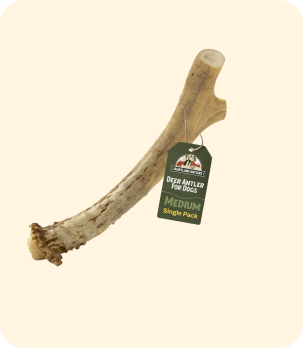
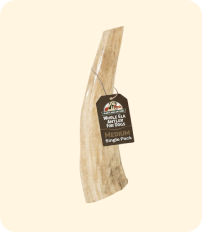
The right antler for a Dachshund is Grade A large split deer (16-32 lb standard, long narrow hunting jaw) lasting 3-5 weeks at daily sessions. Jaw geometry, not weight, is the controlling variable for this breed.

Quick Answer: For a standard Dachshund (16-32 lb), the correct antler is Grade A small split deer. For a miniature Dachshund (under 11 lb), mini split deer, Grade A. The Dachshund's long, narrow hunting jaw cannot grip a cylindrical whole antler. The flat face of a split cut gives the narrow muzzle a contact surface it can hold and work. Deer antler is the right species: elk runs 30-40% denser, which is overbuilt for this jaw size and makes progress frustratingly slow. A Grade A small split deer antler from Heartland Antlers typically lasts a standard Dachshund 3-5 weeks at daily sessions.
The Dachshund is a hunting breed. Small body, long jaw, and a prey drive that does not stop when the chew gets hard. We've tested antler fit across narrow-muzzle breeds and the Dachshund jaw geometry is among the most specific: the flat-face split cut is not a convenience, it is a structural requirement. Standard Dachshunds weigh 16 to 32 lb, miniatures come in under 11 lb, and both variants carry a narrow, long muzzle built for use in tight spaces. The right antler for a Dachshund is small split deer, Grade A for standards and mini split deer, Grade A for miniatures. Weight alone does not get you there. Jaw geometry does.
Most guides read the weight, hand you a small antler, and call it done. What they miss: the Dachshund muzzle is long and narrow, not wide. A cylindrical whole antler does not give that jaw a grip surface. Split deer does. The flat face of a split piece gives the narrow muzzle a contact point it can press into and hold. That is the difference between a dog that engages for 30 minutes and one that sniffs the antler twice and leaves.
The tenacity is real. A Dachshund that defeats a chew is not unusual. It is doing what it was bred for. Grade A deer antler, split, in the right size, is built to absorb that.
Customers with Dachshunds consistently describe the dog ignoring a whole antler that looks correctly sized by weight. After working with Dachshund owners, we've found the narrow elongated muzzle is the controlling factor, not body weight. A piece that a similarly sized broad-muzzled dog can grip becomes unworkable for a Dachshund's narrow jaw. Small split deer gives the narrow muzzle a flat face it can engage from the first session.
Dachshund at a glance: 8-32 lb scent hound in two sizes (standard 16-32 lb, miniature under 11 lb). Long, narrow muzzle designed for underground tunnel pursuit. Scissor bite with surprisingly high relative bite force. AKC hound group. The elongated narrow jaw cannot grip a cylinder; split cut is a structural requirement, not a preference. Prone to IVDD; correct chew fit doubles as a recovery occupancy tool. Requires Grade A small split deer (standard) or mini split deer (miniature).
The Dachshund Chew Profile: Jaw Geometry Drives the Fit
Before fitting an antler, understand what you are fitting it to.
A standard Dachshund (16 to 32 lb) carries a jaw that is long, narrow, and designed for reach and grip in tight underground spaces. The bite force relative to body weight is higher than most people expect from a dog this size. A miniature Dachshund (under 11 lb) scales the jaw proportionally, but the narrow, long muzzle geometry is the same.
The Dachshund's chew style is tenacious and sustained. It picks a grip point on the antler and works the same spot, same angle, same contact zone, returning after breaks. Sessions run longer than most small dogs. A 20 lb Dachshund is not a 20 lb dog's chew problem. It is a hunting-jaw chew problem.
A whole antler is a cylinder. A long, narrow muzzle cannot apply focused use to a cylinder. The dog grips around it but cannot get purchase. Split antler has a flat face and a curved back. The flat face is the grip surface the Dachshund jaw needs. That is the load-bearing reason for the split recommendation, not preference.
Grade A deer antler split is the correct species and cut for a Dachshund: dense enough to last the tenacious sessions this breed puts in, soft enough relative to elk that the jaw-to-body ratio does not cause premature tooth wear. A standard Dachshund (16-32 lb) working a Grade A small split deer antler typically gets 3-5 weeks of daily sessions before the piece needs retirement. Elk density is overbuilt for this jaw size and makes progress frustratingly slow rather than correctly paced.
Best Antler for a Dachshund: Why Split Deer Is the Correct Call
This is where most guides fail because they are working from weight charts, not jaw geometry.
The narrow jaw needs a flat grip surface. A whole antler is cylindrical. For a long, narrow muzzle, a cylinder does not give the jaw a purchase point. The dog grips around it but cannot apply focused use. Split antler has a flat face with exposed marrow and a curved outer surface. That flat face is what keeps the narrow muzzle engaged. A standard Dachshund (16 to 32 lb, long narrow hunting jaw, high-use grip style) is best matched to a small split deer antler, Grade A. The split cut provides marrow access and a flat contact surface that a cylindrical whole antler cannot offer to a narrow muzzle.
Deer, not elk. Elk antler is denser than deer at comparable grades. For a Pit Bull or a Doberman, that density is the right call. For a Dachshund-sized jaw, elk density is unnecessary and a mismatch. The dog does not need to wrestle material harder than its jaw can productively work. Deer antler at Grade A gives the right resistance: enough to last, not so hard the dog cannot make progress.
Grade A is not optional. A persistent dog working the same contact point over long sessions will find every structural weakness in a low-grade piece. Micro-fractures and density variations in B or C grade antler are not a problem for a casual chewer. For a dog returning to the same spot for 45 minutes at a stretch, they are failure points. Grade A deer antler has consistent density and absorbs that focused, sustained pressure without fracturing.
The fit summary: small split deer, Grade A. Not simply small. Specifically small, split, deer, Grade A.
Standard vs. Miniature Dachshund: Size the Variant, Not Just the Breed
The weight gap between standard and miniature Dachshunds is real enough that sizing matters separately for each.
A standard Dachshund weighing 16 to 32 lb with a long, narrow muzzle and high-use bite style is correctly fitted to small split deer, Grade A. The small size matches the body weight. Split matches the jaw geometry. Grade A holds up to the tenacity.
A miniature Dachshund under 11 lb has the same jaw proportions scaled down. The small cut is too large for a miniature. Mini split deer, Grade A, gives the right size and the same flat grip surface the narrow muzzle needs. This is one of the breeds where the standard-versus-miniature size difference matters more than in most. The jaw-to-body proportions do not stay identical as the overall size shrinks.
Get the right size for the specific dog.
The Back Health Angle: Antler as an Occupancy Tool
Dachshunds are prone to IVDD, intervertebral disc disease. It is the most common serious health concern in the breed, affecting roughly 19 to 24 percent of Dachshunds at some point in their lives. A correctly sized Grade A split deer antler is one of the few occupancy tools that keeps a rest-period Dachshund settled for 20-30 minutes without requiring physical exertion.
Recovery periods require keeping an active, driven dog calm and occupied without physical exercise. A long-lasting antler chew serves a real function here. Not because the antler is medicinal. Because a Dachshund with a chew it is genuinely interested in will settle and stay settled. A bully stick is gone in minutes, which does not solve the occupancy problem. A rubber toy does not hold interest for a tenacious chew-driven dog. A Grade A split deer antler matched to the dog's jaw keeps the session going.
For a breed where activity management during recovery is a genuine challenge, the right chew is a practical tool.
Dachshund owners managing IVDD rest periods know how hard it is to keep a motivated, prey-driven dog calm without exercise. A bully stick is gone in under five minutes. A rubber toy gets tossed aside. A Grade A split deer antler in the right size keeps the dog engaged and settled for 20-30 minutes at a stretch, which is exactly the window rest protocols need.
What We Ship for Dachshunds
These are the configurations that fit. Not weight-chart defaults.
| Dachshund Variant | Weight | Correct Antler | Species | Grade |
|---|---|---|---|---|
| Standard adult | 16-32 lb | Small split | Deer | Grade A |
| Miniature adult | Under 11 lb | Mini split | Deer | Grade A |
| Puppy (8+ months) | Any | Mini split, supervised | Deer | Grade A |
| Senior / IVDD recovery | Any | Mini or small split | Deer | Grade A |
Standard adult Dachshund (16 to 32 lb): Small split deer, Grade A. The split cut and the deer density are both load-bearing parts of this recommendation. Do not substitute whole cut and do not substitute elk. The fit is specific.
Miniature adult Dachshund (under 11 lb): Mini split deer, Grade A. Size down from small. Everything else stays: split, deer, Grade A.
Dachshund puppy under 8 months: Skip antlers entirely until adult teeth are fully developed. After 8 months, start with mini split deer under supervision.
Senior Dachshund or dog in IVDD recovery: Mini or small split deer depending on body size. The split cut reduces the hardness demand on teeth and jaw, which matters for senior dogs or dogs asked to chew while in a recovery posture.
The Elk vs. Deer Call for a Dachshund
Deer for this breed. The answer does not change based on individual variation.
Elk is denser than deer. That density is the right match for a crusher jaw (Pit Bull) or a high-use long jaw on a 70 to 80 lb dog (Doberman). For a Dachshund, elk density is overbuilt. The jaw does not need to fight harder material to stay engaged. It needs material that gives just enough feedback to sustain the session.
Grade A deer antler, split, gives the right resistance profile for the Dachshund's jaw size, jaw geometry, and chew drive. Elk, even Grade A, is the wrong density for this body and jaw combination.
How to Read the First Session
Watch the first session for at least 20 minutes. It tells you whether the fit is right.
What you want to see: The dog settles with the antler, finds a grip point on the flat face of the split, and works it steadily. Surface wear is visible at the end of the session. The antler is the same basic shape. The dog returns to it voluntarily after breaks. This is correct fit.
What means wrong size, likely too large: The dog picks it up, carries it around, but cannot find a stable grip to actually chew. Long narrow muzzles on a too-large or whole-cut antler cannot get the use they need. The dog loses interest because the antler does not offer a workable contact point. Downsize, or switch from whole to split.
What means try mini instead of small: The antler is too large for the dog to hold comfortably. The dog is working around the piece rather than into it. This is especially common in miniature Dachshunds given a small cut by mistake. Drop to mini split deer.
What means check grade: The antler has visible fracture lines or develops sharp edges in the first session. This is a grade issue, not a size issue. Confirm Grade A and replace.
Where to Go Next
Small split deer, Grade A, for standard Dachshunds. Mini split deer, Grade A, for miniatures. That is the correct fit built from jaw geometry, not the weight chart.
Find the Right Fit by Breed and Jaw Style to run the full check before ordering, especially if your Dachshund is on the lighter end of the standard range.
Elk vs. Deer Antler: Which Is Right for a Smaller Dog breaks down density and why deer is the correct call for a hunting-jaw breed at this body weight.
Antlers for Senior Dogs: When to Switch to Split covers IVDD recovery configurations and how to adjust the fit when jaw strength changes.
If you have a Poodle in the house alongside your Dachshund, The Right Antler for a Poodle covers a similar size range from a different jaw geometry.
Antlers for Puppies: When to Start and What Size covers the right introduction timeline for Dachshund puppies with developing teeth.
What Grade A Means and Why It Matters explains the density standard that makes Grade A deer antler safe for a tenacious chewer like a Dachshund.
Frequently Asked Questions
What size antler for a Dachshund?
For a standard Dachshund (16 to 32 lb): small split deer, Grade A. For a miniature Dachshund (under 11 lb): mini split deer, Grade A. The split cut matters as much as the size. A whole antler is a cylinder that does not give the long, narrow Dachshund muzzle a usable grip surface. The flat face of a split piece does. Both size and cut are part of the correct fit.
Are antlers safe for Dachshunds?
Yes, with the right fit and grade. The safety risk with antlers comes from two sources: wrong size and wrong grade. For a Dachshund, a whole cut is harder to work safely than split, and lower-grade antler will develop fractures under the tenacious, sustained chew style this breed brings. Grade A split deer in the right size is one of the safest long-duration chews available. Retire the piece once it reaches a size the dog could swallow whole.
Elk or deer antler for a Dachshund?
Deer for Dachshunds. Elk is denser than deer, and that density is the right match for larger, heavier-jawed breeds. For a Dachshund, elk density is overbuilt for the jaw size and body weight. Grade A deer antler, split, gives the right resistance: enough to last, the right hardness for the jaw, and the grip surface the narrow muzzle needs.
Can a Dachshund with back problems have antler?
Yes, with some adjustments. During IVDD recovery or rest periods, choose split over whole to reduce jaw strain, and ensure the dog chews in a comfortable, supported posture, not stretched out or contorted to reach the antler. The long-lasting nature of the chew is genuinely useful during recovery: a settled Dachshund with a chew it likes is easier to keep calm than one that has burned through its chew in five minutes and is looking for something else to do.
How long does an antler last for a Dachshund?
A Grade A small split deer antler typically lasts a standard Dachshund 3 to 5 weeks with regular chewing. The Dachshund's tenacity means it will make consistent progress, but the split cut and deer density are calibrated to last. If the antler is gone or fractured in one session, the grade was wrong. Verify Grade A. If the dog cannot find a grip and loses interest quickly, switch from whole to split, or downsize to mini.
Schema (do not paste into Shopify body_html)
Frequently Asked Questions
What size antler for a Dachshund?
For a standard Dachshund (16 to 32 lb): small split deer, Grade A. For a miniature Dachshund (under 11 lb): mini split deer, Grade A. The split cut matters as much as the size. A whole antler is a cylinder that does not give the long, narrow Dachshund muzzle a usable grip surface. The flat face of a split piece does. Both size and cut are part of the correct fit.
Are antlers safe for Dachshunds?
Yes, with the right fit and grade. The safety risk with antlers comes from two sources: wrong size and wrong grade. For a Dachshund, a whole cut is harder to work safely than split, and lower-grade antler will develop fractures under the tenacious, sustained chew style this breed brings. Grade A split deer in the right size is one of the safest long-duration chews available. Retire the piece once it reaches a size the dog could swallow whole.
Elk or deer antler for a Dachshund?
Deer for Dachshunds. Elk is denser than deer, and that density is the right match for larger, heavier-jawed breeds. For a Dachshund, elk density is overbuilt for the jaw size and body weight. Grade A deer antler, split, gives the right resistance: enough to last, the right hardness for the jaw, and the grip surface the narrow muzzle needs.
Can a Dachshund with back problems have antler?
Yes, with some adjustments. During IVDD recovery or rest periods, choose split over whole to reduce jaw strain, and ensure the dog chews in a comfortable, supported posture, not stretched out or contorted to reach the antler. The long-lasting nature of the chew is genuinely useful during recovery: a settled Dachshund with a chew it likes is easier to keep calm than one that has burned through its chew in five minutes and is looking for something else to do.
How long does an antler last for a Dachshund?
A Grade A small split deer antler typically lasts a standard Dachshund 2 to 5 weeks with regular chewing. The Dachshund's tenacity means it will make consistent progress, but the split cut and deer density are calibrated to last. If the antler is gone or fractured in one session, the grade was wrong. Verify Grade A. If the dog cannot find a grip and loses interest quickly, switch from whole to split, or downsize to mini.