The right antler for boxer dogs is split elk, because the undershot jaw needs a flat surface, not a cylinder.

Quick Answer: For an adult Boxer (55-75 lb), the correct antler is large split elk, Grade A. The Boxer's undershot jaw cannot grip a cylindrical whole antler reliably. The flat face of a split cut gives the lower jaw a stable surface to work against. A Grade A large split elk antler typically lasts an adult Boxer 3-6 weeks at daily sessions. Heartland Antlers ships Grade A split elk sized specifically for this breed's bite geometry.
For a Boxer, the right antler is large split elk, Grade A. That is the starting configuration for most adults in the 55-75 lb range. The split cut is not a compromise for this breed. It is the correct choice for the undershot jaw.
In our experience fitting antler for boxer owners, the switch from whole to split elk resolves grip-and-abandon behavior in the majority of Boxers that previously showed no lasting engagement with antler. The undershot jaw needs a flat surface, not a cylinder.
Most chew guides handle Boxers by pointing to a weight chart and calling it done. Large dog, buy large chew. But they skip the one thing that actually matters for a Boxer: the underbite.
The undershot jaw is breed standard for Boxers. It is also the thing that determines which antler configuration actually works.
Customers with Boxers consistently describe the same carrying-without-chewing pattern: the dog picks up a whole antler, repositions it several times, and sets it down without working it. After working with Boxer owners, we've found the switch to split elk resolves grip-and-abandon behavior in most cases on the first session. The flat marrow face gives the undershot jaw a contact surface it can press into and hold.
Why Split Elk Is the Right Fit for a Boxer's Undershot Jaw
Boxer chew profile: Weight: 50-80 lb Jaw type: Undershot (lower jaw extends beyond upper), front-led grip Chew style: Grip-and-pull, high-frequency multi-angle attack, moderate sustained force Antler specification: Large split elk, Grade A
The Boxer is an undershot breed. The lower jaw extends slightly beyond the upper. This is not a flaw. It is the breed.
What it means for chewing: the classic scissor-bite grip, where upper and lower teeth come together like shears, is not how a Boxer works a chew. Instead, a Boxer grips with the front jaw, pulls, and works the piece from multiple angles. The lower jaw leads. The upper follows. The molars are involved, but less than in a scissor-bite breed.
The chew style that results is grip-and-pull with high energy. A Boxer grabs an end, shakes, repositions, attacks from a different angle. Medium chew intensity by force, but high intensity by frequency and movement. The antler gets worked on all sides rather than ground down from one consistent angle.
Weight range is 50-80 lb. A Grade A large split elk antler typically lasts an adult Boxer 3-6 weeks at regular daily sessions, given the breed's multi-angle chew pattern and moderate bite force. The bite geometry is what most generic chew guides miss entirely.
Elk antler runs 30-40% denser than deer antler at equivalent size. That density is what holds up against the Boxer's high-frequency, multi-angle chew style. A split cut with that density gives the undershot jaw a working surface that stays intact across weeks of daily sessions, not days.
Why Split Works Better Than Whole for Most Boxers
A whole elk antler is a cylinder. Smooth surface, consistent diameter, no natural grip point.
For a scissor-bite breed, that is fine. The teeth come together at an angle that finds purchase on a round surface. The dog can get set and apply sustained pressure.
For a Boxer with an undershot jaw, a whole antler cylinder presents a real problem. The lower jaw extends forward. When a Boxer tries to grip a smooth cylinder, the forward-set lower jaw has nowhere to set against. The antler rolls. The dog repositions constantly. Some Boxers power through this with enough drive. Many lose interest.
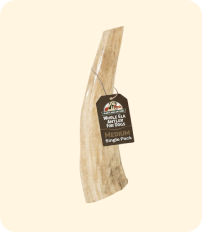
A split antler is different. Split elk has a flat face on one side and the natural outer surface on the other. That flat face, with exposed marrow, gives the Boxer's lower jaw a surface to set against and work. The grip is stable. The dog can apply pressure without the antler rolling away. The marrow reward is immediate and visible rather than buried inside a cylinder.
For Boxers, split is not a compromise. It is the correct cut for the jaw geometry.
Antler for Boxer: What We Ship by Jaw Type and Life Stage
These configurations are based on jaw type, chew style, and weight. Not weight alone.
| Boxer Type | Weight | Correct Antler | Cut | Grade |
|---|---|---|---|---|
| Standard adult | 55-75 lb | Large elk | Split | Grade A |
| High-drive adult | 55-80 lb | Large elk | Whole | Grade A |
| Puppy (under 10 months) | Any | Small/medium deer | Split, supervised | Grade A |
| Senior Boxer | Any | Large elk | Split | Grade A |
Standard adult Boxer (55-75 lb): Large split elk, Grade A. This is the call for most adult Boxers. The split cut gives the undershot jaw a grip surface. Grade A density holds up to the high-energy, multi-angle chew style without fragmenting.
High-drive adult Boxer: Large whole elk, Grade A. Some Boxers chew with enough forward drive and enthusiasm to work a whole piece effectively despite the bite geometry. If your Boxer is particularly focused and persistent, whole elk is worth trying. Watch the first session to see whether the dog is working it productively or losing the grip repeatedly.
Boxer under 10 months: Split deer, supervised. Developing teeth combined with an undershot jaw means split is the right call. The lower density of deer antler is appropriate for a developing bite. Supervision is not optional at this stage.
Senior Boxer: Split elk. Marrow access without demanding full surface pressure on worn or sensitive teeth. The split format keeps the dog engaged without requiring the bite pressure that whole elk demands.
The Elk vs. Deer Call for a Boxer
For adult Boxers, large split elk.
Whole deer is not the right primary chew for an adult Boxer. The density is not matched to the bite energy. A Boxer working a whole deer antler with enthusiasm will get through it faster than the material is designed for, and the density gradient means the outer layer degrades before the core does.
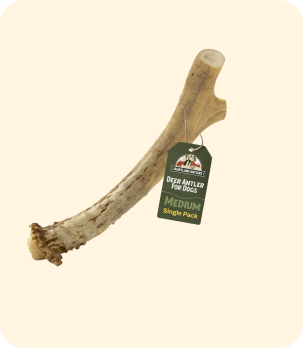
Split deer has a specific and useful role: entry point for a Boxer that has never had an antler before, or a dog working back from dental sensitivity. Not a long-term primary chew for a healthy adult.
Split elk is the consistent answer for adult Boxers. The density holds. The cut fits the jaw. The marrow engagement keeps interest across multiple sessions.
How to Read the First Session
Twenty minutes of watching tells you most of what you need to know.
What you want to see: The dog settles into a consistent working rhythm. The flat face of the split antler is getting worked. Surface wear is visible at the end of the session but the piece is intact. This is correct fit.
What means go up in size or verify grade: Deep gouge marks after one session. Sharp edges developing. The antler is significantly shorter than when you started. This is a grade or size problem, not a breed problem. Order Grade A and size up.
What means try the other cut: You started with whole and the dog keeps losing grip, repositioning every 30 seconds, and walking away frustrated. The undershot jaw cannot find purchase on the cylinder. Switch to split. This is what split is for.
What means normal Boxer behavior: Picking the antler up, carrying it across the room, dropping it, coming back, attacking it from a new angle. This is not a bad fit. This is a Boxer.
The Chew Graveyard Reality
Boxers go through chews. Not always because of bite force. Because of enthusiasm, energy, and the conviction that a different angle will work better than the last one.
If your Boxer has destroyed everything else, rope toys in under an hour, bully sticks before you finish your coffee, and rubber toys that ended up in pieces across the yard, Grade A split elk is built for that pattern. Most Boxer owners who switch to Grade A elk stop replacing chews weekly. The piece is still there after month one.
Bully sticks last a session. Synthetic chews lose their appeal after one encounter. Rope toys become destruction projects. The graveyard fills fast and the cost adds up.
A Grade A large split elk antler, correctly fitted, lasts most Boxers between 3 and 6 weeks of regular chewing. That durability comes from the density of Grade A elk and the split cut keeping the dog engaged without burning through the piece from one aggressive end attack.
The math is straightforward. A chew that holds up for weeks costs less per day than rotating through single-session chews.
Related Reading for Boxer Owners
Before you order, these articles are worth a look:
- What Grade A Means and Why It Matters: the density and sourcing factors that determine whether a piece holds up
- Elk vs. Deer Antler: The Density Difference: why elk density is the right call for adult Boxers
- Find the Right Fit by Breed and Jaw Style: full size guide with jaw geometry considerations
- Are Antlers Safe? The Grade A Answer: what grade means for safety
- How We Grade Antlers for Aggressive Chewers: grade standards that matter for a power chewer breed
- Antler for Bullmastiff: similar jaw anatomy, useful comparison for brachycephalic-adjacent breeds
- Antler for German Shepherd: another high-drive working breed with different jaw geometry
Heartland Antlers Grade A split elk provides a fully exposed marrow face and consistent density throughout. One ingredient: naturally shed elk antler, no flavor coatings, no additives. For a Boxer, the flat cut face is the functional piece of the design. It gives the undershot jaw a surface to work against rather than a cylinder to lose grip on.
Ready to order: Shop Now
Frequently Asked Questions
What size antler for a Boxer?
Large split elk, Grade A, for most adult Boxers in the 55-75 lb range. The split cut matters as much as the size: the undershot jaw gets better purchase on a flat face than on a smooth cylinder. Senior Boxers and those recovering from dental work also do well on large split elk.
Are antlers safe for Boxers?
Yes, with correct fit and grade. The risks with antlers come from undersized pieces and low-grade antler that fragments under pressure. For a Boxer, correct fit means Grade A split elk in the right size. Supervise the first session, and retire the piece when it gets small enough to swallow whole.
Elk or deer antler for a Boxer?
Elk for adult Boxers. Deer antler density is not matched to the bite energy of an adult Boxer working with enthusiasm. Split deer is a reasonable entry point for dogs new to antler or under 10 months. For healthy adult Boxers, large split elk is the consistent recommendation.
Should I get split or whole antler for a Boxer?
Split for most Boxers. The undershot jaw extends forward of the upper jaw, which means a Boxer grips a chew differently than a scissor-bite breed. A whole antler cylinder gives the forward lower jaw no natural grip surface. Split elk provides a flat face to work against, immediate marrow engagement, and a stable grip. High-drive Boxers with strong chew focus can work whole elk effectively, but split is the right starting point.
How long does an antler last for a Boxer?
A Grade A large split elk antler typically lasts a Boxer between 3 and 6 weeks with regular chewing. Duration depends on chew frequency and individual drive. If the antler is significantly reduced after one session, verify Grade A and size up. If the dog loses interest after a few minutes, try split if you started with whole, or check whether the piece is too large to work comfortably.
Schema (do not paste into Shopify body_html)
Frequently Asked Questions
What size antler for a Boxer?
Large split elk, Grade A, for most adult Boxers in the 55-75 lb range. The split cut matters as much as the size: the undershot jaw gets better purchase on a flat face than on a smooth cylinder. Senior Boxers and those recovering from dental work also do well on large split elk.
Are antlers safe for Boxers?
Yes, with correct fit and grade. The risks with antlers come from undersized pieces and low-grade antler that fragments under pressure. For a Boxer, correct fit means Grade A split elk in the right size. Supervise the first session, and retire the piece when it gets small enough to swallow whole.
Elk or deer antler for a Boxer?
Elk for adult Boxers. Deer antler density is not matched to the bite energy of an adult Boxer working with enthusiasm. Split deer is a reasonable entry point for dogs new to antler or under 10 months. For healthy adult Boxers, large split elk is the consistent recommendation.
Should I get split or whole antler for a Boxer?
Split for most Boxers. The undershot jaw extends forward of the upper jaw, which means a Boxer grips a chew differently than a scissor-bite breed. A whole antler cylinder gives the forward lower jaw no natural grip surface. Split elk provides a flat face to work against, immediate marrow engagement, and a stable grip. High-drive Boxers with strong chew focus can work whole elk effectively, but split is the right starting point.
How long does an antler last for a Boxer?
A Grade A large split elk antler typically lasts a Boxer between 3 and 6 weeks with regular chewing. Duration depends on chew frequency and individual drive. If the antler is significantly reduced after one session, verify Grade A and size up. If the dog loses interest after a few minutes, try split if you started with whole, or check whether the piece is too large to work comfortably.