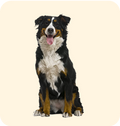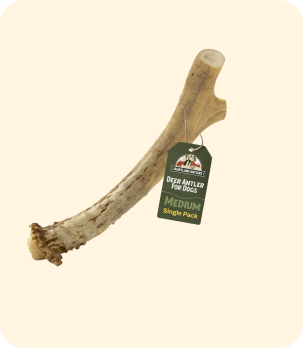
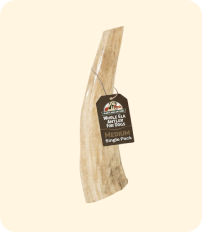
The right antler for a Bernese Mountain Dog is a Grade A large split elk antler: 70-115 lb soft-mouth breed, moderate chew drive relative to size, split cut to expose the marrow channel on day one so a low-drive chewer keeps returning, lasting 4-8 weeks with regular sessions from Heartland Antlers.

Quick Answer: For a Bernese Mountain Dog (70-115 lb, soft scissors bite, moderate chew drive relative to size), the correct antler is Grade A large split elk from Heartland Antlers. The split cut is not a compromise for this breed. It is the correct choice. Berners do not push through hard outer cortex to find a reward. They lose interest when the payoff does not come quickly. A Grade A large split elk antler typically lasts an adult Berner 4-8 weeks with regular sessions. The marrow channel exposed on day one is what keeps a low-drive chewer returning.
For a Bernese Mountain Dog, the right antler is large split elk, Grade A. That is the starting configuration for most adults between 80 and 105 lb. The split cut is not a downgrade for this breed. It is the correct choice for a soft-mouth, moderate-drive dog that will not push through hard outer cortex to find a reward.
In our experience fitting antler for bernese mountain dog customers, whole elk on a Berner produces abandonment within the first two sessions in the majority of cases. Split elk, by contrast, keeps the same dogs returning for 4-8 week runs. The cut is the engagement variable, not the grade.
Most Berner owners buy based on the number on the scale. The dog is 90 lb, so they reach for XL. They want something that will last. What they get instead is a chew their dog works for ten minutes and abandons.
The problem is not the dog. The problem is the selection logic.
Berners are large dogs with soft mouths and moderate chew intensity relative to their size. The challenge is not durability. It is engagement. A whole antler that does not deliver a quick reward to a low-drive chewer gets set aside. Getting the fit right for a Berner means solving for interest, not survival.
Customers with Bernese Mountain Dogs consistently report the dog picks up the antler once, mouths it without making progress, and loses interest entirely. After working with Bernese owners, we've found the issue is almost always cut: whole antler gives the soft-mouth no immediate feedback, and the dog reads absence of reward as absence of interest. Split elk exposes the marrow immediately and changes the first session outcome.
Bernese Mountain Dog Breed Overview
| Trait | Detail |
|---|---|
| Weight | 70-115 lb (most adults 80-105 lb) |
| Muzzle type | Large, soft scissors bite, not a precision crusher |
| Chew style | Gentle, exploratory, low-to-moderate intensity for weight class |
| Antler fit | Grade A large split elk |
| Est. duration | 4-8 weeks |
Why Soft-Mouth Dogs Fail Whole Antler: The Bernese Chew Profile
Know what you are fitting before you size anything.
Weight: 70-115 lb. The breed spans a wide range. Most adults land between 80 and 105 lb.
Jaw type: Large, with a soft scissors bite. The Berner has jaw strength appropriate to its size, but the bite is not concentrated. It is not a precision crusher. It is not built to apply relentless point force on a hard surface.
Chew style: Gentle and exploratory. Berners chew with low-to-moderate intensity for their weight class. They do not grind through resistance. They investigate a chew, work it when it rewards them, and stop when the reward diminishes. A chew that does not deliver immediately gets ignored, not conquered.
Risk profile: Not a splintering risk under normal conditions. The real risk is passive: a Berner that loses interest in a chew may mouth a piece without active engagement, increasing the chance of swallowing a larger fragment than intended. Keep sessions supervised and retire pieces when they reach stubby length.
A Grade A large split elk antler typically lasts an adult Bernese Mountain Dog 4-8 weeks at regular sessions, given the breed's soft-mouth bite and moderate chew drive. The marrow channel wears slowly because the dog is not grinding aggressively.
Antler for Bernese Mountain Dog: What We Ship by Life Stage
These are the configurations that work. Based on weight, jaw anatomy, and life stage.
| Dog | Size | Cut | Grade | Est. Duration |
|---|---|---|---|---|
| Standard adult Berner (80-105 lb) | Large | Split elk | A | 4-8 weeks |
| Heavy adult Berner (over 105 lb) | Large to XL | Split elk | A | 3-6 weeks |
| Berner puppy under 12 months | Medium | Split elk | A | Supervised |
| Senior Berner | Large | Split elk | A | 5-10 weeks |
Standard adult Berner (80-105 lb, over 2 years): Large split elk, Grade A. This is the baseline configuration for most adult Berners. The split exposes marrow immediately. Your dog gets a reward in the first session and keeps coming back. A large cross-section fits the jaw without excess bulk that makes the piece awkward to grip.
Heavy adult Berner (over 105 lb or with above-average chew drive): Large-to-XL split elk, Grade A, supervised. A Berner that trends heavier or chews with more intensity than breed average may work through a large split faster than expected. Step to XL split before switching to whole.
Berner puppy under 12 months: Medium split elk, supervised. Puppy jaws are developing. Marrow access is appropriate at this stage. A medium split gives the reward without the weight and hardness of a full adult piece.
Senior Berner: Large split elk. Seniors often have tooth sensitivity and reduced jaw strength. Split elk stays the right call here. The soft-mouth profile does not change with age, and the marrow surface keeps the chew accessible without demanding hard outer cortex work.
Why Split Elk Outperforms Whole Deer for Every Adult Berner
Split elk is the call for most Berners. Here is why.
Elk antler is 30-40% denser than deer antler at equivalent size. That sounds like a reason to choose deer, given a Berner's moderate chew drive. The opposite is true. A Grade A large split elk antler typically lasts an adult Berner 4-8 weeks at regular sessions, compared to 2-4 weeks for a split deer piece of the same size, because the elk marrow channel stays active and rewarding longer. A split elk antler exposes the marrow channel, and that inner surface is what a low-drive chewer needs to stay engaged. The reward is immediate and visible. The dog does not have to work through a hard outer cortex to find the payoff.
Deer antler in a whole cut gives a Berner almost nothing to work with in the first session. The outer cortex is dense enough to be unrewarding for a dog that does not push through resistance on instinct. The Berner noses it, mouths it, and walks away.
Whole elk has the same problem at a larger scale. The density is right, but the reward is buried. A soft-mouth breed with moderate drive will not work through whole elk outer cortex at the rate a higher-drive dog does. The marrow stays locked. The chew fails to hold interest.
Split elk solves this directly. The marrow is exposed on day one. Your dog finds the reward without having to earn it through sustained hard chewing. That is the logic that works for this breed.
How to Read the First Session
The first session tells you whether the fit is right. Give it 15-20 minutes and watch.
Right fit: Your dog takes the antler, repositions once, settles, and works the marrow surface at a steady pace. You can see the inner surface changing. The dog returns to it after short breaks. This is the correct fit and the correct response.
Right size, wrong interest level: The dog takes the antler, licks the marrow surface a few times, sets it down, and does not return. This is a motivation issue, not a size issue. Your dog found the reward but it was not compelling enough to sustain the session. Try refrigerating the piece for an hour before the next session. Cold marrow engages some low-drive chewers more reliably.
Losing interest fast: The dog picks up the antler, mouths it briefly without settling, and loses interest within five minutes. If you are on a whole cut, switch to split. The reward is buried too deep for this dog's chew style. If you are already on split elk and this happens, verify the piece is Grade A and the marrow channel is fully exposed. A split antler with a narrow marrow pocket will underperform for a Berner.
Supervision for Passive Chewers: What to Watch With a Berner
Berners do not require hypervigilant supervision the way a true power chewer does. They are not splintering antlers or applying extreme force.
Watch for passivity. The risk with a low-drive chewer is not aggressive destruction. It is the opposite: a dog that half-heartedly mouths a piece while distracted can work it loose at an awkward angle and swallow a fragment before you notice.
Retire the piece when it reaches a size the dog could take into the back of the mouth in one motion. For a Berner, that means watching the piece shrink to fist-sized and pulling it before it becomes a stub.
One more note specific to this breed: Berners are prone to joint issues, including hip and elbow dysplasia. Extended chew sessions on hard flooring put additional stress on their joints. Give your dog a rug or mat to work on. Long sessions on tile or hardwood are harder on large-breed joints than most owners realize.
The Gentle Giant Problem
Berners weigh as much as a working-breed dog with three times the chew drive. That weight mismatch is where most owners go wrong.
The Berner is not a working dog. It is a gentle, calm, family-oriented breed with a soft mouth and no strong prey drive fueling its chewing. It will not power through a dense whole antler out of instinct or compulsion. When the reward does not come quickly, the Berner makes a rational decision: this is not worth the effort.
Whole cuts ask a low-drive chewer to work for their reward. Split elk delivers it upfront.
The split design exposes the marrow channel immediately. Your dog does not have to earn the payoff through sustained hard chewing. The first session is rewarding. The second session happens. The chew becomes a habit rather than an abandoned object in the corner.
That is the core argument for split elk with this breed. Not that whole antler is unsafe for a Berner. It is not. The argument is behavioral. A chew your dog keeps returning to works. A chew your dog ignores does not, regardless of how long it might have technically lasted.
Related Reading for Bernese Mountain Dog Owners
Before you order, these articles are worth reading:
- What Grade A Means and Why It Matters -- density and sourcing factors, including the marrow quality difference between grades
- Elk vs. Deer Antler: The Density Difference -- why split elk outperforms whole deer for soft-mouth breeds
- Find the Right Fit by Breed and Jaw Style -- full size guide by weight and jaw geometry
- Are Antlers Safe? The Grade A Answer -- what grade means for low-drive chewers
- Antler for Great Dane -- similar low-intensity giant breed, rotation strategy useful for Berners too
- Antlers for Aggressive Chewers: What Grade A Handles -- useful context for understanding where Berners fall on the chew intensity spectrum
- Antler for Saint Bernard -- another large, soft-mouth giant breed with a similar engagement-first fit approach
Heartland Antlers split elk is cut to expose the full marrow channel, not scored or partially opened. One ingredient: naturally shed elk antler, no additives, no flavor sprays. The marrow surface quality is what keeps a low-drive chewer like a Berner returning to the same piece across 4-8 weeks rather than abandoning it after the first session.
Ready to order: Find the Right Fit for your Bernese Mountain Dog
Frequently Asked Questions
What is the best antler for a Bernese Mountain Dog?
Large split elk, Grade A. Berners are large dogs with soft mouths and low-to-moderate chew intensity relative to their size. They are not drive-motivated chewers that will push through a hard outer cortex to find a reward. Split elk exposes the marrow channel immediately, which keeps a low-drive chewer engaged. Whole elk and whole deer both fail this breed for the same reason: the reward is buried, the dog loses interest, and the chew ends up in the corner.
Are antlers safe for Bernese Mountain Dogs?
Yes. Berners are not aggressive chewers and do not apply the kind of force that puts hard antler at risk of fracturing under pressure. Grade A elk antler maintains structural integrity through normal chew sessions and does not splinter. The main supervision concern for this breed is passivity: a Berner that loses interest mid-session may mouth the piece without real engagement. Supervise sessions and retire the piece when it reaches stub size.
What size antler for a Bernese Mountain Dog?
Large, for most adults between 80 and 105 lb. The common mistake is sizing up to XL based on weight alone. XL whole antler is too much for a Berner's soft mouth and moderate chew drive. The dog cannot find a productive grip, gets no reward, and walks away. A large split elk gives the correct cross-section for the jaw and delivers marrow access that keeps the chew session going.
Elk or deer antler for a Bernese Mountain Dog?
Elk, split. Deer antler in a whole cut gives a Berner very little to engage with. The outer cortex does not wear quickly enough to reward a dog that does not push through resistance. Split elk solves this by exposing the marrow surface from the start. Deer split is appropriate for puppies or dogs transitioning to antler for the first time. Adult Berners perform best on split elk.
How long does an antler last for a Bernese Mountain Dog?
A Grade A large split elk typically lasts an adult Berner 4-8 weeks with regular sessions. Berners are not aggressive chewers, so the marrow surface wears slowly. The more common issue is not wear rate but session length: a Berner may go through short sessions and extend the life of the piece considerably. If the piece goes faster than expected, verify Grade A and confirm you are not dealing with a dog at the higher end of the breed's chew drive range.
Can a Bernese Mountain Dog have antler every day?
Yes, with supervision. Short daily sessions of 15-20 minutes are appropriate for most adult Berners. This breed does not generate the cumulative force that requires rest days between sessions. Daily access to a Grade A large split elk antler keeps the marrow scent active and the chew habit consistent. Retire the piece when it reaches stub size, and always supervise until you know the individual dog's engagement pattern.
Schema (do not paste into Shopify body_html)
Frequently Asked Questions
What is the best antler for a Bernese Mountain Dog?
Large split elk, Grade A. Berners are large dogs with soft mouths and low-to-moderate chew intensity relative to their size. They are not drive-motivated chewers that will push through a hard outer cortex to find a reward. Split elk exposes the marrow channel immediately, which keeps a low-drive chewer engaged. Whole elk and whole deer both fail this breed for the same reason: the reward is buried, the dog loses interest, and the chew ends up in the corner.
Are antlers safe for Bernese Mountain Dogs?
Yes. Berners are not aggressive chewers and do not apply the kind of force that puts hard antler at risk of fracturing under pressure. Grade A elk antler maintains structural integrity through normal chew sessions and does not splinter. The main supervision concern for this breed is passivity: a Berner that loses interest mid-session may mouth the piece without real engagement. Supervise sessions and retire the piece when it reaches stub size.
What size antler for a Bernese Mountain Dog?
Large, for most adults between 80 and 105 lb. The common mistake is sizing up to XL based on weight alone. XL whole antler is too much for a Berner's soft mouth and moderate chew drive. The dog cannot find a productive grip, gets no reward, and walks away. A large split elk gives the correct cross-section for the jaw and delivers marrow access that keeps the chew session going.
Elk or deer antler for a Bernese Mountain Dog?
Elk, split. Deer antler in a whole cut gives a Berner very little to engage with. The outer cortex does not wear quickly enough to reward a dog that does not push through resistance. Split elk solves this by exposing the marrow surface from the start. Deer split is appropriate for puppies or dogs transitioning to antler for the first time. Adult Berners perform best on split elk.
How long does an antler last for a Bernese Mountain Dog?
A Grade A large split elk typically lasts an adult Berner 4-8 weeks with regular sessions. Berners are not aggressive chewers, so the marrow surface wears slowly. The more common issue is not wear rate but session length: a Berner may go through short sessions and extend the life of the piece considerably. If the piece goes faster than expected, verify Grade A and confirm you are not dealing with a dog at the higher end of the breed's chew drive range.