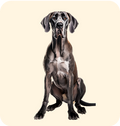

Finding a chew for a Great Dane is actually two problems at once: finding something durable enough to last more than a session, and finding something large enough not to become a hazard. Most products labeled for "aggressive chewers" or "large breeds" were designed with a 60 - 80 lb dog in mind. For a 150 lb Dane, that chew isn't just inadequate - it's potentially dangerous once it wears down to a size that can be swallowed or lodged.
This isn't a criticism that comes up much in generic chew guides because Great Danes aren't the most common search subject. But for Dane owners, the sizing problem is the problem - and it shapes every purchase decision.

The Great Dane Chewing Challenge: Size Comes First
Great Danes are the tallest domestic dog breed, with adult males routinely reaching 140 - 175 lbs and some individuals exceeding 200 lbs. Females typically run 110 - 140 lbs. The jaw opening of an adult male Dane is substantial - large enough that a chew which would be appropriate for a 60 lb Labrador becomes a swallowable object the moment it wears down.
That's not hyperbole. It's geometry. The threshold for a chew becoming a choking risk is relative to jaw width, not just body weight. A Dane's jaw will accommodate objects that would never fit in a smaller dog's mouth, which means the margin of error on undersized chews is much narrower.
Here's the practical consequence: a chew that a Labrador could work safely for three weeks becomes a discard-immediately item for a Dane once it reaches the 3 - 4 inch point - because at that size, it can fit. This changes the entire calculus on which products are appropriate.
XL is the minimum for any adult Great Dane under about 120 lbs. Giant is the correct call for most adult Danes, and non-negotiable for dogs over 150 lbs. A chew that is too large is not a problem. A chew that is too small is.
Heartland's XL and Giant sizes are specifically designed for this weight class - see the size guide for the full breakdown.
Are Antler Chews Safe for Great Danes?
Yes - when correctly sized and from a quality source.
The two most common chew safety concerns for giant breeds are splintering and swallowing large pieces. Grade A naturally shed antler addresses both. The outer cortex of a quality whole antler is dense and does not splinter - this distinguishes it from cooked bones, which fracture into sharp shards. Dogs gnaw antler incrementally, working the surface down slowly over many sessions, rather than biting off and swallowing large chunks the way they do with rawhide or bully sticks.
For Dane owners who are also thinking about bloat (gastric dilatation-volvulus, a serious and breed-prevalent condition): antler chewing is low-risk in this context because dogs don't swallow large pieces. The concern with GDV is large volumes of food, water, or swallowable material entering the stomach rapidly. Antler doesn't produce that - it produces fine powder from surface abrasion, ingested in small amounts over a long session. That's a meaningful distinction from rawhide, which softens and gets swallowed in chunks, or from standard bully sticks, which dissolve and disappear whole.
Single-ingredient and no chemical processing means no digestive upset from artificial preservatives or additives - relevant for a breed whose owners are already health-conscious about everything that goes into their dog.
Supervise the first 2 - 3 sessions with any new antler. Learn how your Dane approaches it - some gnaw carefully, some work it with more pressure - and size accordingly. Replace the antler when it wears to 2 - 3 inches regardless of how much of the chew remains. At that point, it has served its purpose.
For a full review of antler safety, see are antler chews safe for dogs.

What Are the Best Chews for Great Danes?
One important thing to understand about Great Danes before matching a chew: they are not uniformly extreme power chewers. The stereotype of the "gentle giant" has a behavioral basis. Many Danes are moderate chewers - interested and engaged, but not the kind of dog that applies every pound of force to every session. Others are persistent, high-drive chewers. Both exist within the breed, and the right antler type depends on which dog you have.
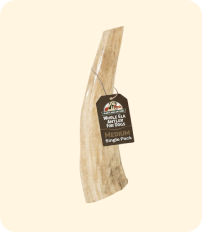
1. Whole Elk Antler (XL or Giant) - Primary Recommendation for Most Danes
Whole elk antler is the right starting point for the majority of Great Danes. The natural shape provides multiple grip points for a large jaw - a giant dog can engage from different angles, which extends session length and interest. The density is appropriate for moderate-to-regular chewers: hard enough to last weeks, but not so dense that it becomes frustrating for dogs on the less aggressive end of the chewing spectrum.
The outer cortex resists sustained work without fracturing. The internal marrow provides motivation. For a breed where many individuals are perfectly satisfied with a durable, engaging chew that doesn't disappear in minutes, whole elk hits the right balance.
Best for: Most adult Great Danes (18 months+), moderate to regular chewers, first-time antler buyers.
2. Split Elk Antler (XL or Giant) - Best First Antler for New Dane Owners
Split elk antler - cut lengthwise to expose the marrow - is the correct introduction for Danes that have never had antler before, or for owners who aren't yet sure of their dog's chewing style. The exposed marrow engages immediately, which overcomes the "my dog ignores it" problem that some first-time antler buyers encounter.
Split elk is slightly softer than whole elk, which makes it less appropriate as a long-term primary chew for a heavy-chewing Dane. But as a gateway product - to build the habit and confirm that your dog engages reliably - it's the right choice. Once your Dane is clearly enthusiastic, transition to whole elk.
For more on this decision, see split vs. whole elk antler for dogs.
Best for: Danes new to antler, moderate chewers, owners establishing the antler routine.
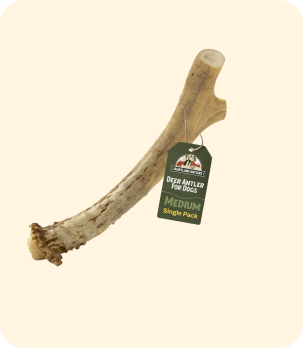
3. Deer Antler (XL or Giant) - For High-Drive, Power-Chewing Danes
Deer antler is denser than elk antler, with a harder outer cortex that resists more sustained jaw pressure. It's the right call for the Dane that is genuinely a power chewer - the dog that works through a whole elk antler in a matter of days rather than weeks, or applies focused, intense pressure during chewing sessions.
These Danes exist. They're not the majority, but for the owner whose Dane has surprised them with how quickly good chews disappear, deer antler is the answer. The density extends session life significantly. See best dog chews for aggressive chewers for context on where deer antler sits in the overall durability hierarchy.
Best for: High-drive, power-chewing adult Danes; dogs that have worked through whole elk too quickly.
What NOT to Give a Great Dane
- Rawhide - Softens under moisture and can be swallowed in large pieces. For a giant breed jaw, this is a meaningful GI risk.
- Standard bully sticks - Gone in minutes for any large dog, and a Dane will swallow the end piece whole. Not a functional chew for this size class.
- Any standard-sized chew - Products sized for 40 - 80 lb dogs are a hazard once they wear down. The rule is Giant first for most adult Danes.
- Nylon chews - Synthetic surface with no nutritional value; abrasive friction can cause wear on teeth over time.
What Size Antler for a Great Dane?
This is the most important table in any chew guide for this breed. When in doubt, always go one size up - a chew that is too large is inconvenient; a chew that is too small is dangerous.
| Weight | Recommended Antler | Size |
|---|---|---|
| 100 - 120 lbs | Whole Elk or Split Elk | XL |
| 120 - 150 lbs | Whole Elk or Deer Antler | XL or Giant |
| 150 - 175 lbs | Deer Antler or Whole Elk | Giant |
| 175+ lbs | Deer Antler | Giant |
The rule for Danes: Default to Giant unless your dog is under 120 lbs. The Giant designation exists for a reason, and Great Danes are exactly who it was built for.
Use the Heartland size guide if you want a more detailed breakdown by chewing intensity and individual dog measurements.
Antler Chews and Great Dane Joint Health
Giant breeds carry an elevated risk of musculoskeletal problems throughout their lives - hip dysplasia, elbow dysplasia, early-onset arthritis, and joint degeneration are documented at higher rates in very large dogs than in medium-sized breeds. It's one of the reasons Great Dane owners tend to be thoughtful about nutrition and supplementation.
Antler marrow contains calcium, phosphorus, and collagen - minerals that play a structural role in bone density and connective tissue. This is not a therapeutic supplement claim; a chew does not replace a veterinary joint support protocol. But as a naturally occurring source of the building blocks that support musculoskeletal health, the marrow is a nutritional bonus that soft chews, nylon toys, and rawhide don't provide.
For Dane owners already thinking about joint support as a breed-specific priority, the fact that the chew itself contributes trace structural minerals - rather than being a purely synthetic or chemically processed product - is a meaningful distinction.
See what is antler marrow for dogs for the full breakdown of what's inside a split elk antler.
Great Dane Puppies: When Can They Start?
Great Danes grow at an exceptional rate - a Dane puppy at 6 months may already outweigh many adult dogs of smaller breeds. That growth rate is part of why giant breed puppy development requires more caution than average, not less.
- Under 6 months: No hard chews. Baby teeth cannot handle antler, and developing bone is still forming.
- 6 - 14 months: Split elk XL only. The softer marrow-exposed side is appropriate for Dane puppies in this window, with supervision. Whole elk and deer antler are too hard before adult teeth are fully set.
- 14 months and beyond: Transition to whole elk. Deer antler can be introduced at 14 - 18 months for dogs whose adult teeth appear strong and fully developed.
Giant breed puppies have accelerating bone growth that makes their developmental windows different from medium or large breeds. When in doubt, wait. The benefit of graduating to whole antler at 14 months versus 12 months is minor; the risk of hard chew damage to developing teeth during rapid growth is not.
Frequently Asked Questions
Is whole elk or deer antler better for a Great Dane? For most Great Danes, whole elk antler in XL or Giant is the better starting point. Danes are large but not universally extreme power chewers - whole elk's moderate hardness suits the majority of the breed. Deer antler is the right choice for Danes that chew with real intensity and work through whole elk quickly. When in doubt, start with whole elk and upgrade to deer antler if needed.
What size antler for a 150 lb Great Dane? A 150 lb Great Dane needs a Giant antler - no exceptions. At that body weight, any XL antler becomes a potential choking hazard as it wears down. Giant whole elk antler or Giant deer antler are the correct options for a Dane in the 150 - 175 lb range.
Are antler chews safe for giant breed dogs? Yes - with correct sizing. The most important safety rule for giant breeds is that the antler must always be larger than the dog can get fully into its mouth. Grade A naturally shed antler does not splinter, which removes the primary hazard associated with bones and cheap chews. Dogs gnaw antler incrementally rather than swallowing large pieces, making it safer than rawhide or bully sticks for giant breeds. Always supervise the first few sessions and retire any antler worn down to 2 - 3 inches.
How long does an antler chew last a Great Dane? A Grade A Giant whole elk antler typically lasts a moderate-chewing Great Dane 2 - 6 weeks. For Danes with more intense drive, Giant deer antler will last longer - often 3 - 8 weeks - because of its denser outer cortex. Compared to bully sticks or rawhide, antler chews deliver dramatically more total engagement time. See how long do antler chews last for lifespan estimates by chewing intensity.
Can Great Dane puppies have antler chews? Not before 6 months. Great Dane puppies grow exceptionally fast, but their developing teeth and bones need time before handling hard chews. From 6 - 14 months, split elk in XL only - the softer, marrow-exposed side is appropriate with supervision. Whole elk and deer antler should wait until 14 months, when adult teeth are fully set. Giant breed puppies have faster growth rates than other dogs, which makes early-life tooth and joint protection especially important.
The Right Chew for a Giant Dog
For most adult Great Danes, Giant or XL whole elk antler is the answer - naturally shed, Grade A, no splintering, odor-free and mess-free, long-lasting. For the Danes with real chewing drive, Giant deer antler is waiting.
Not sure where your Dane falls? Start with whole elk XL or Giant. If your dog works through it in under a week, upgrade to deer antler. If your dog is just getting to antler for the first time, start with split elk to build the habit.
Use the Heartland size guide to match by weight, and browse the full deer antler collection for XL and Giant options.
Free shipping on orders over $50. All antlers are Grade A, naturally shed, and sourced in North America.