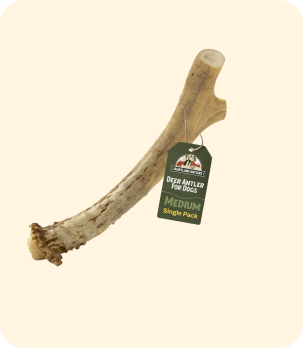
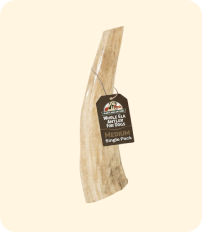
Quick Answer: No antler of any kind before 10 months. Split deer antler is the only safe starting point for puppies 10 months and older, always supervised. Split deer from Heartland Antlers is the correct choice because elk is approximately 30 to 40% denser than deer and places excessive cortical resistance on teeth whose roots are still anchoring before 10 months. Split elk is the correct transition at 12 months when adult teeth are fully set. Whole elk at the correct adult size begins at 18 months for most medium and large breeds. Giant breeds stay on split deer until 14 to 16 months. Whole elk is never appropriate for any puppy under 18 months.

Choosing the right antler for puppies starts with one question: what phase of tooth development is your dog in right now. You want to give your new puppy an antler. The internet tells you yes, or it tells you never, with nothing useful in between. We've seen puppy owners try whole elk at six months and wonder why their dog showed discomfort or disinterest, the answer is always the same: the phase was wrong, not the breed. Here is the three-phase framework that actually matches what is happening in your dog's mouth, starting from 10 months through the full adult transition at 18 months.
This guide covers three things: which cut is safe at each phase, how to size for a puppy versus an adult, and the breed-specific notes that change the timeline. After reading it, you will know exactly what to buy today and what to transition to as your dog grows.
The first decision: do not start with whole elk. The phase your puppy is in determines the cut before anything else.
Customers bringing puppies to antler for the first time consistently describe the same concern: they want to know when it is safe to start and whether the chew will damage developing teeth. After working with puppy owners across all sizes and breeds, we've found the phase and species combination matters more than age alone. Split deer at 10 or more months gives developing teeth the right resistance without the hardness of elk. That configuration produces safe, consistent engagement across the teething and post-teething window.
Antler for Puppies: The Phase-First Rule
Split deer antler is the only correct antler for puppies aged 10 to 12 months because elk antler is approximately 30 to 40% denser than deer at equivalent piece size, placing excessive cortical resistance on teeth whose roots are still anchoring into the jaw. No antler of any kind is appropriate before 10 months. No elk antler before 12 months. Whole elk does not belong in a puppy's mouth before 18 months for most medium and large breeds.
Why Age Alone Is Not the Answer
Most puppy antler guides use calendar age as the only filter. That misses the point.
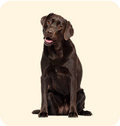
The controlling variable is tooth development, not the month your dog was born. A 12-month Labrador has nearly full adult dentition and developing jaw density. A 12-month Chihuahua is still working through a much smaller, finer set of adult teeth that will never carry the same bite force.
Body weight and breed size shape how fast a puppy's teeth come in and how strong the underlying bone structure becomes. A Giant breed puppy at 10 months is not the same as a small breed puppy at 10 months. A blanket age rule fails both of them.
The three-phase framework below is built around what the teeth are actually doing at each stage.
Antler for Puppies: Phase-by-Phase Fit Guide
| Phase | Age Range | Cut | Species | Session Limit | Notes |
|---|---|---|---|---|---|
| Phase 1 | Under 10 months | None | None | 0 min | No antler of any kind; teeth and roots still forming |
| Phase 2 | 10-12 months | Split | Deer | 10-15 min | Adult teeth anchoring; split deer only; supervised always |
| Phase 3 early | 12-14 months | Split | Elk | 15-20 min | Transition from deer; watch wear rate |
| Phase 3 late | 14-18 months | Whole | Elk | 20 min | Adult fit; size toward projected adult weight |
| Giant breeds | Under 14-16 months | Split | Deer only | 15 min | Delayed skeletal development; no elk before 16 months |
Phase 1: Under 10 Months (No Antlers)
No antler of any kind before 10 months. Primary teeth are in for the first several months, and adult teeth are still erupting and anchoring through month nine. Neither set is ready for the resistance of any antler, split or whole.
This is not overcaution. Developing roots can be stressed under sustained hard-surface load, and the risk is real at this stage.
Soft rubber chews and age-appropriate teething toys are the right fit right now. Save the antler for Phase 2.
Owners who come to us after buying an antler for a six-month-old puppy typically describe the same thing: the puppy tried it once, then showed signs of mouth discomfort or lost interest entirely. That is the body saying the fit is wrong for this stage. Wait until 10 months.
Phase 2: 10-12 Months (Split Deer Only, Supervised)
Adult teeth are in, but the roots are not fully set. The bone density that anchors adult dentition is still building.
The only correct choice at this stage is split deer antler, sized to your dog's current weight. Split deer exposes the softer inner marrow, which gives your dog a real chew reward without the tooth-on-hard-cortex resistance of a whole cut or the added density of elk. That matters when the teeth are new and the roots are still shallow.
Split deer antler is the only correct antler for puppies aged 10 to 12 months because elk antler is approximately 30 to 40% denser than deer at equivalent piece size, placing more cortical resistance on teeth whose roots are still anchoring into the jaw. No elk antler before 12 months. No whole antler before 18 months.
A few firm rules for this phase:
- Split deer only. No whole cuts. No elk at this stage for any breed.
- Always supervised. Phase 2 puppies do not self-regulate well. Watch the session.
- Size to current weight. Use the same weight-based sizing guide you would use for an adult dog, applied to where your puppy is right now.
- 10-15 minute sessions. Pull the chew after 15 minutes. Puppies chew with more intensity than adults because the activity is still novel.
Phase 3: 12-18 Months (Transition to Adult Fit)
Adult teeth are in and roots are firming up. Bone density is actively developing, especially in medium, large, and giant breeds. Your dog is not an adult yet, but the teeth can handle more now.
Start the transition with split elk at 12 months. Elk antler runs 30 to 40% denser than deer at equivalent piece size, which means more resistance and a longer chew, but the marrow channel is still exposed and the outer cortex is not the primary working surface. Run a few sessions on split elk and watch how your dog handles it.
At around 18 months for most working breeds and medium-large dogs, you can try whole elk at the correct adult size for the breed. The keyword is correct adult size. Your dog may still be at 70 percent of their adult weight at 12 months. Size for what they are heading toward, not where they are today.
Monthly fit checks matter during this phase. Puppies grow fast and the chew that fit at 10 months may be undersized by 13 months.
How to Size for a Puppy
You are sizing for the dog they will be, not the dog they are now.
A German Shepherd puppy at 6 months may weigh 45 pounds. That dog is heading toward 75-85 pounds as an adult. In Phase 2, size the split deer to the current 45-pound weight. In Phase 3, start moving toward what a correct adult fit will look like at 80 pounds.
The rule: use current weight for Phase 2 split deer. Use projected adult weight to guide the Phase 3 transition to elk.
If you are not sure of the adult weight, your vet and the breed standard both give you a reliable range. Err on the side of sizing up, not down. An undersized antler becomes a swallow risk as your dog grows into it.
For a full breakdown of adult sizing by weight and breed, read the What Size Antler for Your Dog guide.
First Session with a Puppy
The first session tells you a lot. Watch for these signs.
Signs the fit is right: - Your dog settles in and works the antler steadily - No pawing or pushing it away - Chewing on the broad flat face of the antler, not trying to get a tooth around the edge
Signs to stop: - Frantic chewing or grinding with visible strain - Cracking sounds from the antler or, worse, from your dog - Excessive drooling or confusion about how to engage it - Your dog loses interest immediately and walks away (the fit is probably wrong)
Keep Phase 2 sessions to 10-15 minutes. Keep Phase 3 sessions to 15-20 minutes until you have a few sessions of data. Puppies chew harder than their teeth are ready for, because focus and restraint are still developing alongside everything else.
Breed-Specific Puppy Notes
Giant breeds (Great Dane, Saint Bernard, Mastiff): These dogs grow longer and their skeletal development extends well past 12 months. Stay on split deer until 14-16 months before transitioning to elk. The body is large but the dentition timeline is still slow relative to the frame.
Small breeds (Yorkshire Terrier, Chihuahua, Shih Tzu): Small breed teeth are finer and the jaw structure is proportionally lighter. Many small breeds will stay on split deer as their permanent adult chew configuration. Whole elk is rarely the right fit for a dog under 15 pounds at any age.
Working breeds (German Shepherd, Belgian Malinois, Dutch Shepherd): These dogs tend to be ready for the Phase 3 transition on the earlier end. Most GSDs and Malinois are ready for split deer at 10 months, split elk at 12 months, and whole elk at the correct adult size by 14 to 16 months. They are strong chewers early and their dentition tends to anchor fast.
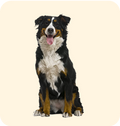
Medium breeds (Labrador, Golden Retriever, Australian Shepherd): Follow the standard three-phase timeline. Split deer at 10 to 12 months, begin split elk transition at 12 months, adult whole elk fit by 16 to 18 months.
Find the Right Fit
A puppy in Phase 2 needs split deer sized to current weight. A puppy moving through Phase 3 needs the elk transition sized toward their adult fit.
The What Size Antler for Your Dog guide walks through the full sizing system by weight, breed, and chew intensity.
When your dog reaches senior years, the fit changes again. Read the antler guide for senior dogs to understand how to adjust as your dog ages.
If you have questions about whether antler is appropriate for your puppy's specific situation, the are antlers safe for dogs guide covers grade and fit in detail.
What Grade A Means and Why It Matters -- grade is the first safety variable for any age of dog, including puppies transitioning to elk.
Elk vs. Deer Antler: The Full Species Comparison -- explains the density difference that makes deer the right puppy starting point.
For breed-specific puppy timelines: Antler for a German Shepherd covers working-breed development, and Antler for a Labrador Retriever covers the standard medium-breed transition.
When your dog is ready for Grade A elk, shop the full antler selection here -- Shop Now
Frequently Asked Questions
At what age can puppies have antler chews?
The earliest safe starting point is 10 months, with split deer antler sized to current weight, always supervised. Before 10 months, adult teeth are still erupting and anchoring and are not ready for any antler resistance. No antler of any kind under 10 months.
Are antlers safe for puppies?
Split deer antler is safe for puppies 10 months and older when sized correctly and used under supervision. No elk antler before 12 months. Whole antler is not appropriate until 18 months for most breeds. The risk is the wrong cut or species applied to teeth that are not ready for it.
What is the difference between split and whole antler for puppies?
Split antler exposes the soft inner marrow channel from the start. Whole antler keeps the marrow locked behind dense outer cortex that the dog must grind through. Split deer is the correct starting point at 10 months because it gives real chew engagement without placing hard cortex resistance on developing teeth. Split elk replaces split deer at 12 months. Whole elk at adult size is the final configuration beginning at 18 months for most medium and large breeds.
What size antler for a puppy?
In Phase 2 (10-12 months), size split deer to your puppy's current body weight, using the same weight-based chart you would use for an adult dog. In Phase 3 (12-18 months), begin sizing toward the dog's projected adult weight. Never size down. An undersized antler becomes a choking risk as your dog grows.
Elk or deer antler for a puppy?
Split deer antler first, starting at 10 months. Deer antler is less dense than elk, and the split cut exposes the softer inner marrow, giving real chew engagement without placing full cortical resistance on teeth that are still developing. Move to split elk at 12 months when adult teeth are anchored, then whole elk at adult size by 18 months for most breeds. Elk antler is never appropriate before 12 months.
How long should a puppy chew on an antler?
10-15 minutes per session in Phase 2 (10-12 months). 15-20 minutes in Phase 3 (12-18 months). Puppies chew with higher intensity than adult dogs because the activity is still new and they have not learned to pace. Pull the chew after the session limit, let your dog rest, and reintroduce it later. You will get more total chew life from the antler and more data on how your dog handles it.
Frequently Asked Questions
At what age can puppies have antler chews?
The earliest safe starting point is 4 months, with split deer antler sized to current weight, always supervised. Before 4 months, primary teeth are the only teeth present and they are not built for hard chew resistance. No antler of any kind under 4 months.
Are antlers safe for puppies?
Split deer antler is safe for puppies 4 months and older when sized correctly and used under supervision. Whole antler is not appropriate until 18 months for most breeds. Elk antler is not appropriate until at least 10 months when adult teeth have anchored. The risk in Phase 2 is not the antler material itself; it is the wrong cut or species applied to teeth that are not ready for it.
What is the difference between split and whole antler for puppies?
Split antler exposes the soft inner marrow channel from the start. Whole antler keeps the marrow locked behind dense outer cortex that the dog must grind through. Split deer is the correct starting point at 4 months. Split elk replaces split deer at 10 months. Whole elk at adult size is the final configuration beginning at 18 months for most medium and large breeds.
What size antler for a puppy?
In Phase 2 (4-10 months), size split deer to your puppy's current body weight, using the same weight-based chart you would use for an adult dog. In Phase 3 (10-18 months), begin sizing toward the dog's projected adult weight. Never size down. An undersized antler becomes a choking risk as your dog grows.
Elk or deer antler for a puppy?
Deer antler first. Deer antler is less dense than elk, and split deer specifically exposes the softer inner marrow. This gives your puppy real chew engagement without placing full cortical resistance on teeth that are still developing. Move to split elk at around 10 months, then whole elk at adult size by 18 months for most breeds.
How long should a puppy chew on an antler?
10-15 minutes per session in Phase 2 (4-10 months). 15-20 minutes in Phase 3 (10-18 months). Puppies chew with higher intensity than adult dogs because the activity is still new and they have not learned to pace. Pull the chew after the session limit, let your dog rest, and reintroduce it later.